
Choose Your Risks
Lessons from Alex Honnold on fear, preparation, and mastery

In January, renowned climber Alex Honnold scaled the 1,667-foot Taipei 101 skyscraper in Taiwan without ropes or safety equipment. The 90-minute ascent was broadcast live on Netflix.
Since then, I’ve rewatched Free Solo for the tenth time and listened to him on podcasts. Inspired, I dusted off my harness, shoes, and chalk bag at the gyms here in Boulder.
I climbed anything I could as a kid. Out of my crib. Up the biggest tree in our front yard, which was so tall the fire department had to rescue me with a cherry picker. I was two. In grade school, I’d race my brother’s friends, three years older, up the ropes.
Swimming and baseball eventually took over, but I always enjoyed being up high.
A recovering frat bro, sick of the bar scene in Philly, climbing was a post-grad passion of mine. I met like-minded people, introduced friends to the sport, and blew off some steam after work.
Then triathlon took over, which ultimately brought me to Colorado. I assumed I’d occasionally climb here, but it was hard to find time and energy for another sport on top of three.
And with my mindset (and ignorance), I of course wanted to become world-class at climbing too. I still do, but have accepted that there are tradeoffs I must make.
Anyway, here are a few lessons I’ve learned from Alex Honnold…
The thing that most stands out to me about Alex is his pure love for climbing.
He was a regular at his local climbing gym by age 10. Despite competing on an international level as a teen, he claims he wasn’t naturally gifted. Even to this day, after accomplishing the unimaginable, he points out that most of his professional climbing friends are physically stronger than him.
But that didn’t deter him. He loved climbing so much that he did it five to six days a week and never stopped.
His 2017 free solo climb of El Capitan, Spanish for “The Captain” or “The Chief,” is one of the most impressive athletic achievements of all time.
Pro climber, National Geographic photographer, and Oscar-winning filmmaker Jimmy Chin described the achievement as if everyone in the world was talking about breaking the two-hour barrier for a marathon, and suddenly, someone shows up and runs a marathon in under one hour.
For those unfamiliar, El Cap is a 3,000-ft granite monolith in Yosemite National Park. At twice the height of the Empire State Building, it’s the center of the rock climbing universe and has attracted ambitious seekers from all over the world for generations.
The first ascent in 1958 took 45 days. Today, most teams complete the climb in 3-5 days, using ropes, gear, and portaledges to sleep on the wall. Alex climbed it in less than four hours, with nothing but his rubber shoes and a chalk bag.
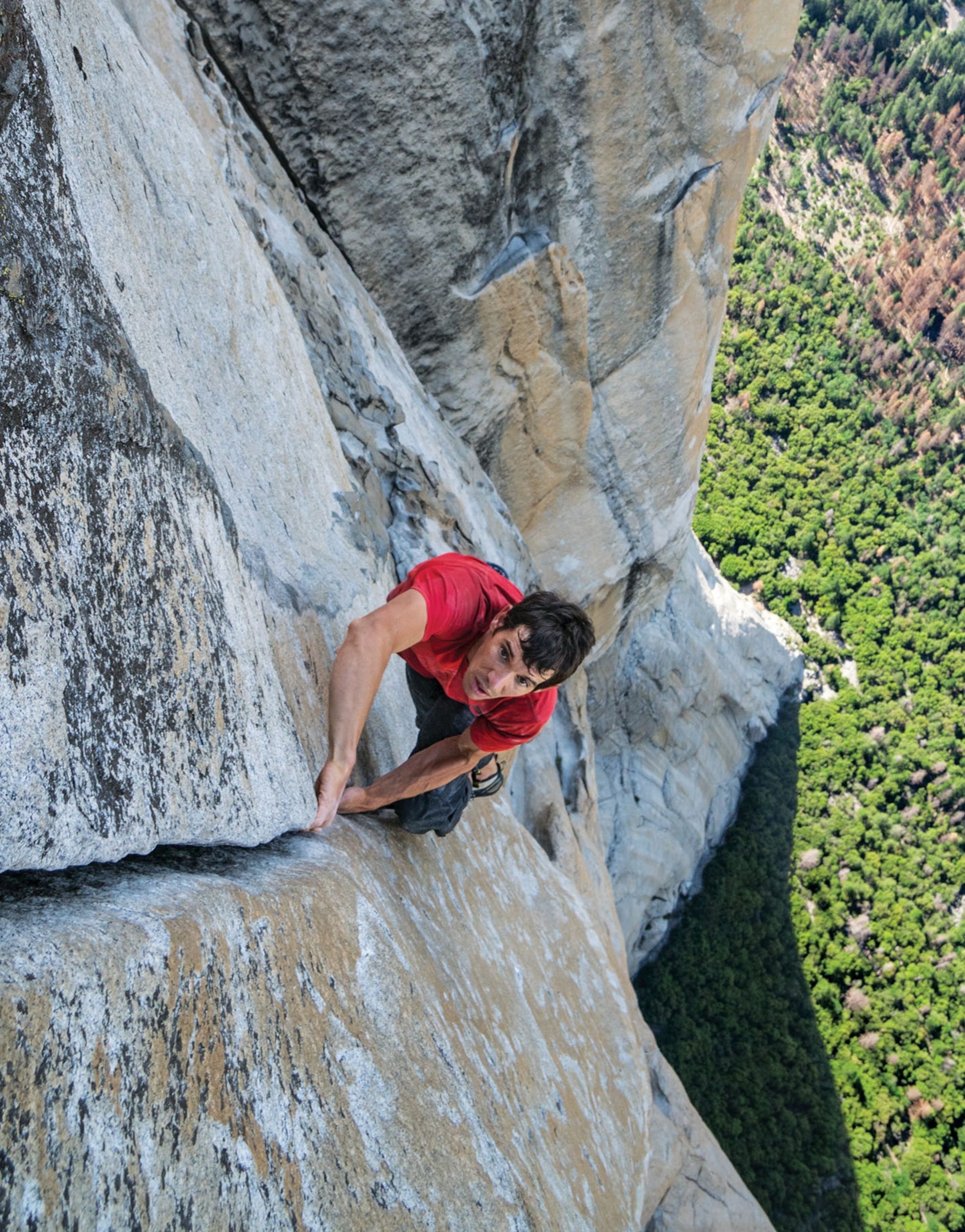
While he’s soloed thousands of times, he gradually worked his way up to the big walls in Yosemite. In 2008, he free soloed Moonlight Buttress, 1,300 feet of sandstone, in Zion. Months later, at just 23, he ascended the Northwest Face of Half Dome, a 2,000-foot world-class route that brought him mainstream recognition. Nearly a decade later, he achieved his lifelong dream of soloing El Cap in 2017.
This was no accident. It was the culmination of 20 years committed to a craft and a specific path. While he’s mastered the psychological side, his psych and stoke to climb are also on another level.
Each year, he would spend a season in Yosemite on the wall—practicing with ropes, getting reps. He choreographed and rehearsed every move—every hand hold, every foothold. Why? Volume negates luck.
Growing up, his mom used to say, “Presque ne compte pas,” which translates to “almost doesn’t count” and “good enough isn’t.”
Through constant exposure, he desensitized himself. Each day on the wall, he felt scared, but he faced his fear because his goal demanded it.
He visualized. Not only success in standing on the summit, but the worst case scenario in plummeting to his death. He imagined these situations in his mind so that if they presented themselves in reality, he wasn’t experiencing them for the first time when the stakes were high.
Alex’s intense training and methodical preparation is highlighted in his differentiation of risk and consequence.
Most people use risk to mean something that seems dangerous; however, Alex prefers to describe risk as the likelihood of something happening, and consequence as what will happen if it does.
Just because the consequences are incredibly high (death), if the likelihood is incredibly low, it could still be reasonable to do that thing.
Alex lives an intentional life. When Alex was 19, his father dropped dead of a heart attack. He was only 55. This had a profound impact on Alex and reminded him of his own mortality. While an outsider may feel he’s engaging in reckless behavior, Alex is consciously choosing his own risks.
Whether or not we realize it, we’re all taking risks. You take risks as a climber, but you also take risks living a sedentary life or catching a buzz at a bar on the weekend. You have a higher likelihood of heart disease or getting in a car accident.
Because we’re all going to die, isn’t it better to take calculated risks to pursue a fulfilling life rather than avoid risk altogether?
“The correct way to manage fear is to gradually broaden your comfort zone until your comfort zone includes things that seemed previously impossible.”
- Alex Honnold
Absolutely love this post Adam. You neglected to mention as tyke climbing on a dining room chair to get on top of the dining room table and then jumping up to swing on the chandelier. Keep ascending Son
I have been running since June of 2020. But I am amazed by what Alex Honnold does, not because of the sheer tenacity to do these SOLO routes or now you can say sky scrapper as well. A lot of people do things which are high stakes but lows consequences but what Honnold does is High Stakes & High Consequences. His demeanor to be calm & composed is quite high when his life is on the line. That's what he lays emphasis on by saying when the consequences are quite high, one is totally immersed and isn't bound to make mistakes, so making a mistake goes out of the window.
I have also listened to every possible podcast of him.
The more he keeps on doing this, the more I want to know what goes in his mind, how he formed his cognition over the period of years for more than 3 decades while practicing climbing. People from the outside view it as risk but for him it is his default. For people F1 drivers are at risk as well while driving those cars w/o much safety even though they have the latest tech and safety equipments installed. It is the same as a knife in toddler's hand is dangerous but it is safe if it handled with care by a teenager. Knife is the same but it is who handling that.
He also reframes risk as that risk is everywhere. People deciding driving after drinking is also risk and every other thing is a risk. What sits at top for any human is to decide/choose the Risks for their lives.
Alex shows that one can incorporate Carol Dweck's growth mindset in one's life and it can help in every facet of life. Not clinging to things or even fears. Fear is not reality. It is some what a construct of mind and we can move the needle of raising of alarm for sure in every walk of life but it can only be done when we firstly accept yeah the improvement can be done by putting in the work over the period of time.